
The Incident:
Catching a 14,002-Call Token Drain
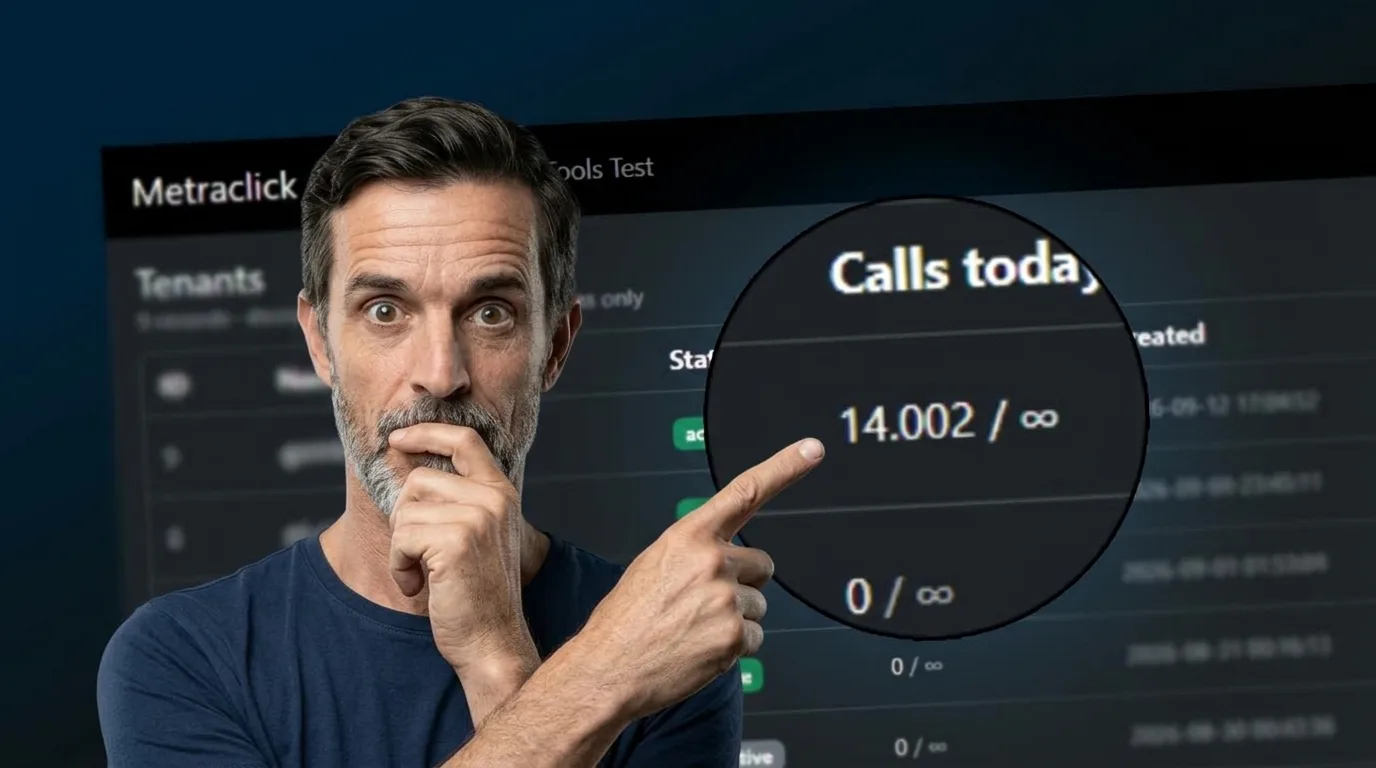
The alert arrived on a routine Wednesday morning. Our MCP admin dashboard flagged one client's agent at 14,002 tool calls in a few hours, against a baseline of 100 to 500 requests per day. A tool call is one request the agent sends to its tools, and the dashboard line climbed with every refresh.
An MCP server is the standard interface between an AI agent and its tools. This agent works inside the client's CRM.
Left unchecked, that rate would have burned through tokens (the units of work the model bills for), pushed API costs up, and overwhelmed the CRM. KohlerCode runs that infrastructure and watches it continuously, so the loop was stopped early.
The Solution:
One Function Instead of 14,000 Calls
The loop needed a better tool, not a tighter leash.
Our Hermes administrator agent produced a precise specification for the missing function.
Our AI coding tool implemented it in the MCP server as a bulk retrieval call. It runs on managed MCP servers we operate for the client, the layer that logs every request.
The agent now collects the dataset in one call. The loop ended, call volume returned to normal, and token consumption dropped.
That is AI automation as a toolset: the agent keeps the judgment, the infrastructure does the volume.
The Diagnosis:
Unpredictable Models and Proactive Monitoring
KohlerCode runs a multi-tiered architecture. Our Hermes agents, our internal AI agents, monitor and manage client-facing agents across isolated servers. Our administrator agent read the client's logs to find the cause.
The root cause: the CRM search tool was capped at 50 results per query. Asked to work through thousands of contacts, it did not report the limit. It called the same restricted tool 14,000 times to collect the dataset page by page.
The agentic reality: was this a KohlerCode deployment bug? No. Models in agentic workflows, where the AI chooses its own next step instead of following a script, do not behave predictably. The simplest route was the call that already worked, repeated thousands of times at a cost far above the limit it was trying to beat. That is the classic agentic failure mode: a per-record workaround for a bulk problem. Rules tight enough to block every detour would also block the judgment the agent is hired for. Continuous monitoring, updated memory, and cleanup are not optional.
The Standard:
Human Verification on Every Change
Autonomous diagnosis and code generation make maintenance faster, but at KohlerCode they never replace senior engineering judgment. Every architectural change, generated function, and MCP deployment is audited by our own engineering team before it reaches production. An engineer reads the change, confirms it does what the specification asked and nothing more, and validates it before release.
This is the KohlerCode standard: enterprise AI integration, bottlenecks resolved before they become operational costs, and human oversight on every change. Your agents run securely and economically while you focus on your business, all for one fixed monthly price.

Free Discovery Call
Ready to put your first AI employee to work?
Book your free AI discovery call today, and we will show you exactly how a custom AI agent can take work off your team's plate within the first month.